eCommerce
PorTecnofin Team
Goodbye to "Copy and Paste": 7 Critical Reasons to Integrate Your eCommerce with Your ERP
The silent enemy of profitability in e-commerce is not the lack of sales, but operational inefficiency. Many businesses start managing their online store and internal management (ERP) as two separate islands. The result: employees copying data back and forth, stock errors, and dissatisfied customers.
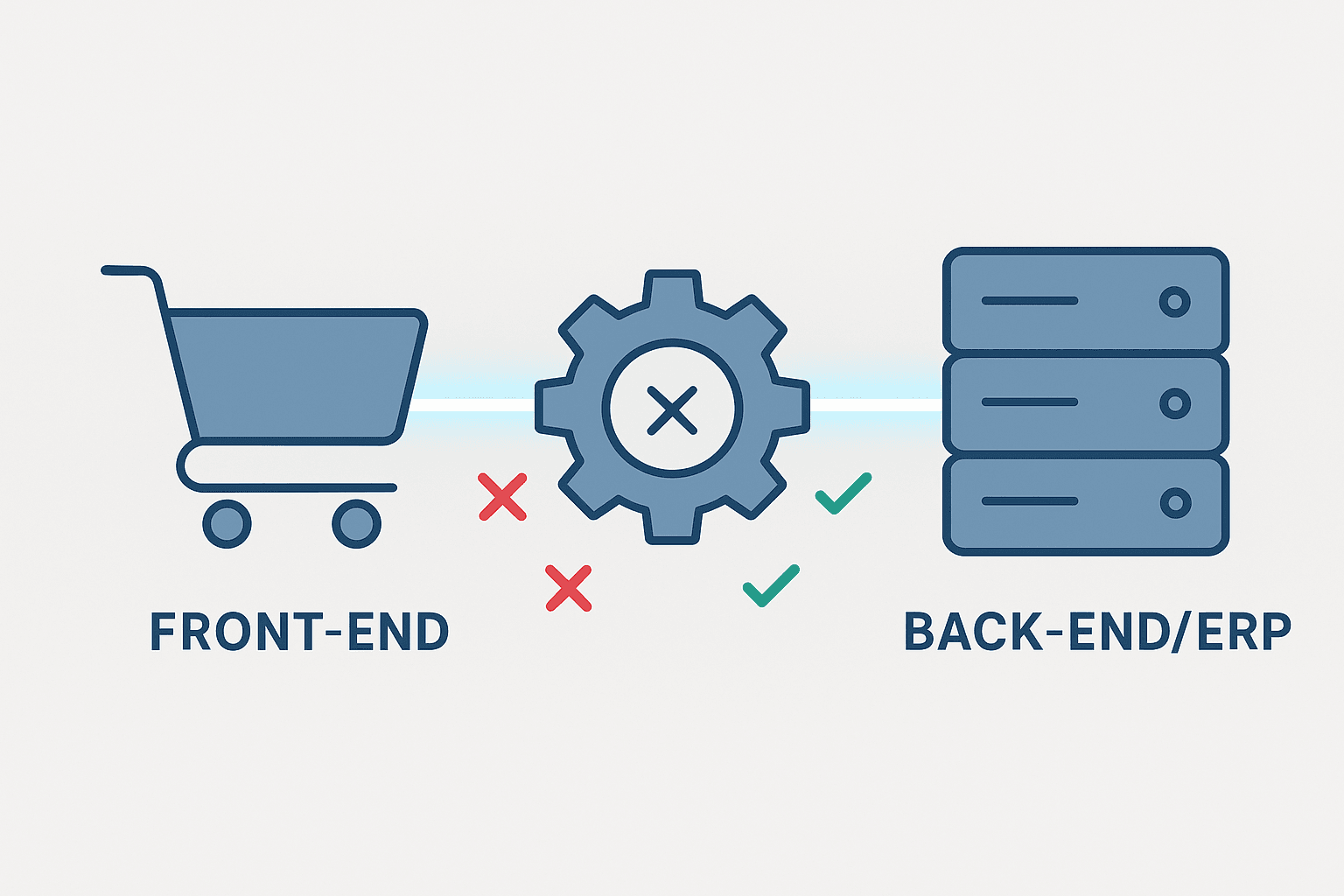
At TECNOFIN, we know that a beautiful online store is useless if the back office is chaotic. The integration between your eCommerce and your Enterprise Resource Planning (ERP) system is the technological bridge that transforms a manual business into an automated sales machine.
Here we technically explain why this connection is vital for the health of your company:
1. Real-Time Inventory: The End of "Overselling" There is nothing worse for brand reputation than selling a product that you no longer have in stock. By integrating both systems, the stock is synchronized bidirectionally. If you sell one unit over the phone and it's recorded in the ERP, the website reflects it instantly. No more selling smoke and order cancellations due to out-of-stock issues.
2. Price and Catalog Automation Do you have 5,000 references? Manually updating prices on two platforms is unfeasible and prone to human error. With solid integration, any pricing, offer, or technical sheet change you make in your ERP is automatically reflected in your online store. A single management point, multiple updated sales channels.
3. "Hands-Free" Orders Without integration, processing an order involves re-entering shipping and billing data. With integration, the order travels from the website to your warehouse and accounting without human intervention. This drastically reduces processing time (Lead Time), allowing you to ship faster and with zero transcription errors in addresses.
4. Unified Customer Information (360°) When a customer calls support, your team needs to see everything: web purchase history, old invoices, and credit status. Integration centralizes the data. It allows you to offer personalized commercial conditions (such as specific B2B prices) on the website based on the customer's profile stored in the ERP.
5. Up-to-Date Accounting and Invoicing Forget about generating invoices at the end of the day one by one. The payment gateway confirms the transaction and the ERP automatically generates and sends the electronic invoice. This not only saves administrative hours but also keeps your tax obligations in strict order and in real-time.
6. Real Scalability If processing 10 orders daily takes you one hour manually, processing 100 will take you ten hours. That is not scalable. Automation breaks that barrier: the system processes 10 or 1,000 orders with the same effort. Technology absorbs the workload, not your staff.
7. Accurate Business Intelligence (BI) You cannot improve what you do not measure. By having all data flow unified, your profitability reports are real. You will know exactly which channel is most profitable, which products have the highest turnover, and where your money leaks are based on consolidated financial data, not estimates.
Conclusion: Automate to Grow Keeping eCommerce and ERP separate is a handbrake on your growth. The investment in integration pays for itself with the savings in hours/man and the elimination of logistical errors.
At TECNOFIN, we are experts in building these digital bridges. No matter which ERP you use (SAP, Microsoft Dynamics, Sage, Oracle, or custom developments), we have the technical capacity to connect it with your virtual store. Contact us today to request a quote; let us handle the technology while you focus on selling.

Tecnofin is your trusted partner in the e-commerce sector. We have a team of expert developers who provide personalized service to help you design a virtual store that meets the specific needs of your business. Don't hesitate to contact us to receive a quote for the ideal store for your company!