Marketing
PorTecnofin Team
Beyond the "click": How to structure profitable advertising campaigns for your e-commerce.
Having a functional and attractive virtual store is the first big step. The second, and often the most challenging, is ensuring that the right customers find it at the right time. This is where an advertising campaign stops being an optional expense and becomes a strategic and measurable investment.
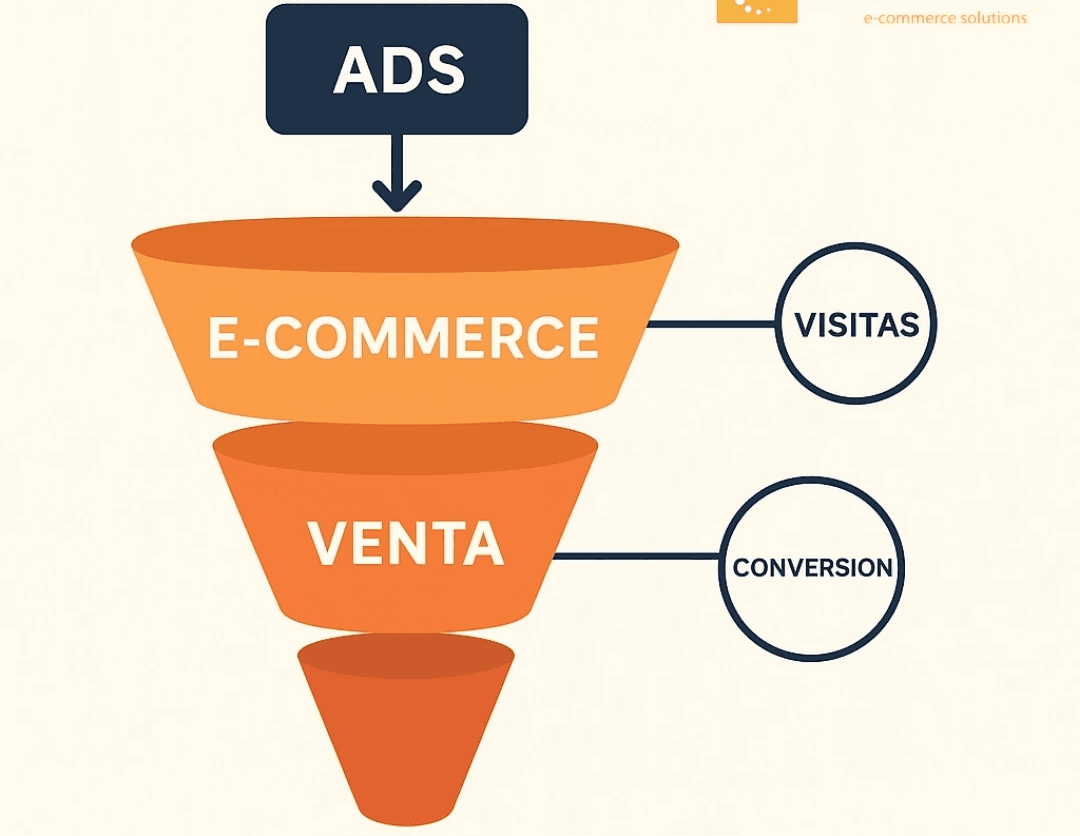
The common mistake is thinking that "advertising" is simply "putting up ads". The reality is that a campaign is a complex project, a system designed to attract qualified traffic and efficiently convert it into sales for your e-commerce.
In this article, we will break down what exactly an advertising campaign is in the context of e-commerce and what the pillars are that support it to be profitable.
What is an Advertising Campaign Really?
Let’s think of an advertising campaign not as an isolated ad, but as a coordinated communication effort. It is a set of strategic actions and messages, disseminated through specific channels (such as Google, Meta, TikTok, or email), that are executed over a defined period and with a very clear business objective.
For an e-commerce, that objective is usually directly tied to profitability. We are not just looking for "likes" or "views"; we are looking for concrete actions.
The most common objectives in a virtual store are:
Sales Generation (Conversion): The most direct. We want the user to buy.
Product Launch: To showcase a new line or specific item.
Lead Generation: To obtain the visitor's email in exchange for a discount, to nurture them in the future.
Remarketing: To recover users who added products to the cart but did not complete the purchase.
The 4 Pillars of a Successful E-commerce Campaign
For a campaign to generate a positive return on investment (ROI), it must be built on a solid foundation. If any of these pillars fail, the entire structure weakens.
1. The Objective (The "What For" Measurable)
The first step is to define what we want to achieve, and "selling more" is not a specific enough objective. We need clear metrics.
Are we looking to increase total sales by 20% this quarter?
Do we want to achieve a ROAS (Return on Advertising Spend) of 5:1? (That is, for every dollar invested, generate five in sales).
Do we need to reduce the Cost per Acquisition (CPA) of a new customer to less than $15?
A clear objective defines success and allows us to make optimization decisions based on data, not intuition.
2. The Target Audience (The "For Whom")
The most costly mistake in digital advertising is trying to talk to everyone. The success of segmentation lies in precision. It is not the same to sell running shoes to an experienced marathoner than to someone just starting to jog.
Here is where we define our Buyer Persona:
How old are they? Where do they live?
What problems are they looking to solve with your product?
What social media do they consume? At what time?
What motivates them to shop online? (Price, convenience, exclusivity).
Knowing your customer thoroughly allows us to segment with surgical precision on advertising platforms, ensuring your budget is spent only on those most likely to buy.
3. The Message and Creativity (The "What" we say)
Your ad competes against photos of friends, breaking news, and entertainment videos. You have less than three seconds to capture attention.
The message must be a powerful combination of:
Copy (Text): Clear, direct, and focused on the customer's benefit, not just on the product's features.
Creative (Image or Video): It must be high quality and consistent with your brand identity. In e-commerce, video (like reels or TikToks) often performs better for demonstrating the product in use.
Call to Action (CTA): What do you want the user to do? "Buy now", "Discover the collection", "Get 10% OFF". It should be a clear command.
The message must be relevant to the audience you defined in the previous pillar.
4. The Channels and Measurement (The "Where" and the "How Are We Doing")
Not all channels work for all objectives. The choice of platform is strategic:
Google Ads (SEM): Perfect for capturing "existing demand". We target people who are already actively searching for your product or solution on Google. Google Shopping campaigns are vital for e-commerce.
Social Media (Meta Ads, TikTok Ads): Ideal for "creating demand". We impact users with demographic profiles and interests aligned to your brand, even if they are not actively searching for you at that moment. It is excellent for discovery and branding.
Email Marketing: Essential for retention. It is the most cost-effective channel to communicate with existing customers, recover abandoned carts, and encourage repurchase.
Once the campaign is active, the real work begins: measurement and optimization. We analyze key metrics such as CTR (Click-Through Rate), CPC (Cost per Click), and, most importantly, the Conversion Rate. If an ad isn’t working, it is paused. If a target audience responds well, more budget is allocated to it.
Advertising is not Magic, It’s Strategy
A successful advertising campaign for a virtual store is not based on luck or on "promoting a post" and hoping for the best. It is a meticulous system that aligns a clear business objective with a deep understanding of the customer, a relevant message, and constant measurement.
It is the engine that brings quality traffic to the virtual store you worked so hard to build.
Do you want to stop experimenting with ads and start designing profitable and predictable sales systems for your e-commerce? At TECNOFIN, we not only build your store but also design the digital advertising strategy to fill it with customers.
Contact our experts today and request a personalized quote for your project.

Tecnofin is your trusted partner in the e-commerce sector. We have a team of expert developers who provide personalized service to help you design a virtual store that meets the specific needs of your business. Don't hesitate to contact us to receive a quote for the ideal store for your company!